> ## Documentation Index
> Fetch the complete documentation index at: https://next.gentrace.ai/docs/llms.txt
> Use this file to discover all available pages before exploring further.
# Datasets
> Create and manage datasets with test cases for AI evaluation in Gentrace.
Datasets in Gentrace are collections of test cases used to evaluate your AI models and pipelines. They provide a structured way to organize your test data, track performance over time, and ensure consistent evaluation across different model versions.
## What are datasets?
A dataset is a container that holds multiple test cases for a specific pipeline. Each test case consists of:
* **Inputs** - The data passed to your AI model
* **Expected outputs** - The desired response from your model
* **Name** - A descriptive identifier for the test case
* **Metadata** - Additional context and information
Datasets enable you to:
* Run systematic evaluations across multiple test cases
* Compare model performance between different versions
* Track evaluation metrics over time
* Import and export test data in various formats
## Creating datasets
You can create datasets through the Gentrace web interface or programmatically using the SDK.
### Creating via web interface
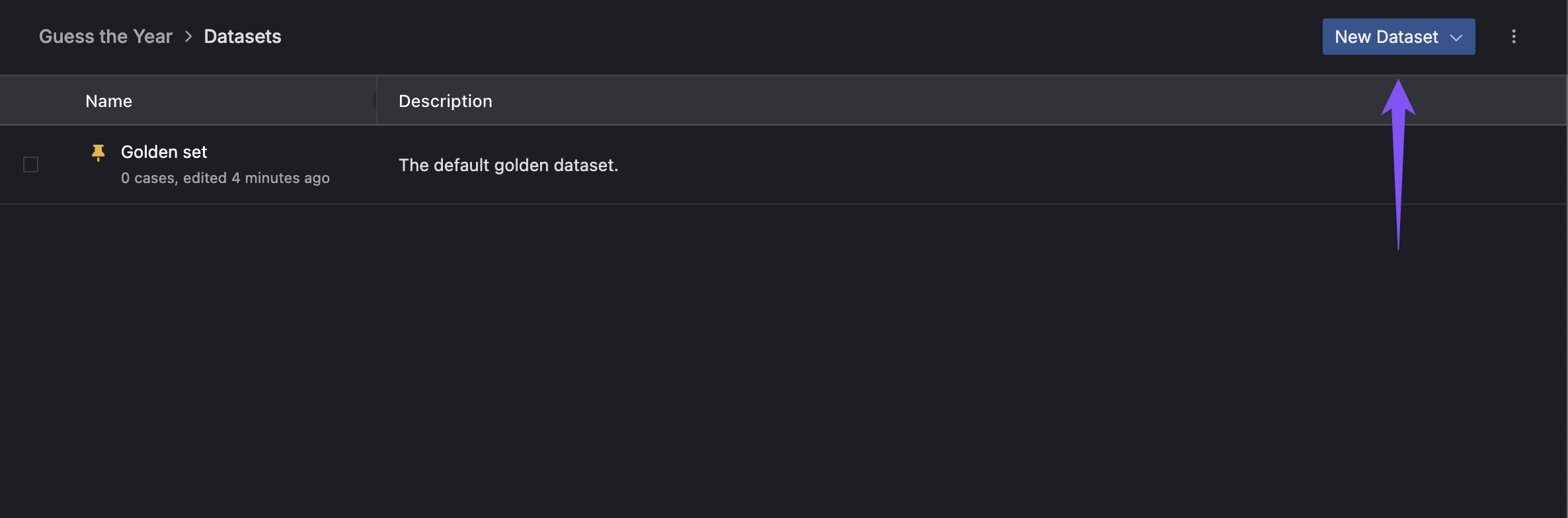
1. Navigate to your pipeline in the Gentrace dashboard
2. Click "New Dataset" to create a dataset for your pipeline
3. Give your dataset a descriptive name and description
 ### Creating via SDK
```typescript theme={null}
import { init, datasets } from 'gentrace';
init({
apiKey: process.env.GENTRACE_API_KEY,
});
const dataset = await datasets.create({
name: 'Customer Support Evaluation',
description: 'Test cases for customer support chatbot responses',
pipelineId: 'your-pipeline-id', // or use pipelineSlug
});
console.log('Created dataset:', dataset.id);
```
```python theme={null}
import os
from gentrace import init, datasets
init(api_key=os.environ["GENTRACE_API_KEY"])
dataset = await datasets.create(
name="Customer Support Evaluation",
description="Test cases for customer support chatbot responses",
pipeline_id="your-pipeline-id" # or use pipeline_slug
)
print("Created dataset:", dataset.id)
```
## Managing test cases
Test cases are the individual data points within your dataset. You can create them one at a time or in bulk.
### Creating single test cases
```typescript theme={null}
import { init, testCases } from 'gentrace';
init({
apiKey: process.env.GENTRACE_API_KEY,
});
const testCase = await testCases.create({
datasetId: 'your-dataset-id',
name: 'Billing inquiry',
inputs: {
query: 'How do I cancel my subscription?',
context: 'Customer has active premium plan',
},
expectedOutputs: {
response:
'To cancel your subscription, please visit your account settings...',
confidence: 0.9,
},
});
```
```python theme={null}
import os
from gentrace import init, test_cases_async
init(api_key=os.environ["GENTRACE_API_KEY"])
test_case = await test_cases_async.create(
dataset_id="your-dataset-id",
name="Billing inquiry",
inputs={
"query": "How do I cancel my subscription?",
"context": "Customer has active premium plan"
},
expected_outputs={
"response": "To cancel your subscription, please visit your account settings...",
"confidence": 0.9
}
)
```
### Listing test cases
```typescript theme={null}
// List all test cases in a dataset
const testCasesList = await testCases.list({
datasetId: 'your-dataset-id',
});
// Access the test cases
for (const testCase of testCasesList.data) {
console.log(testCase.name);
console.log(testCase.inputs);
}
```
```python theme={null}
# List all test cases in a dataset
test_case_list = await test_cases_async.list(
dataset_id="your-dataset-id"
)
# Access the test cases
for test_case in test_case_list.data:
print(test_case.name)
print(test_case.inputs)
```
### Updating and deleting test cases
```typescript theme={null}
// Retrieve a specific test case
const testCase = await testCases.retrieve('test-case-id');
// Delete a test case
await testCases.delete('test-case-id');
```
```python theme={null}
# Retrieve a specific test case
test_case = await test_cases.retrieve("test-case-id")
# Delete a test case
await test_cases.delete("test-case-id")
```
## Managing datasets
### Listing datasets
```typescript theme={null}
// List all datasets
const datasetList = await datasets.list();
// Filter by pipeline
const filteredDatasets = await datasets.list({
pipelineId: 'your-pipeline-id',
archived: false, // Exclude archived datasets
});
// Access the datasets
for (const dataset of datasetList.data) {
console.log(dataset.name);
console.log(dataset.description);
}
```
```python theme={null}
# List all datasets
dataset_list = await datasets.list()
# Filter by pipeline
filtered_datasets = await datasets.list(
pipeline_id="your-pipeline-id",
archived=False # Exclude archived datasets
)
# Access the datasets
for dataset in dataset_list.data:
print(dataset.name)
print(dataset.description)
```
### Updating datasets
```typescript theme={null}
// Update dataset properties
const dataset = await datasets.update('dataset-id', {
name: 'Updated dataset name',
description: 'New description',
isArchived: false,
isGolden: true, // Mark as golden dataset
});
```
```python theme={null}
# Update dataset properties
dataset = await datasets.update(
"dataset-id",
name="Updated dataset name",
description="New description",
is_archived=False,
is_golden=True # Mark as golden dataset
)
```
## Importing data
You can import test cases from CSV, JSON, or JSONL files to quickly populate your datasets.
### CSV import
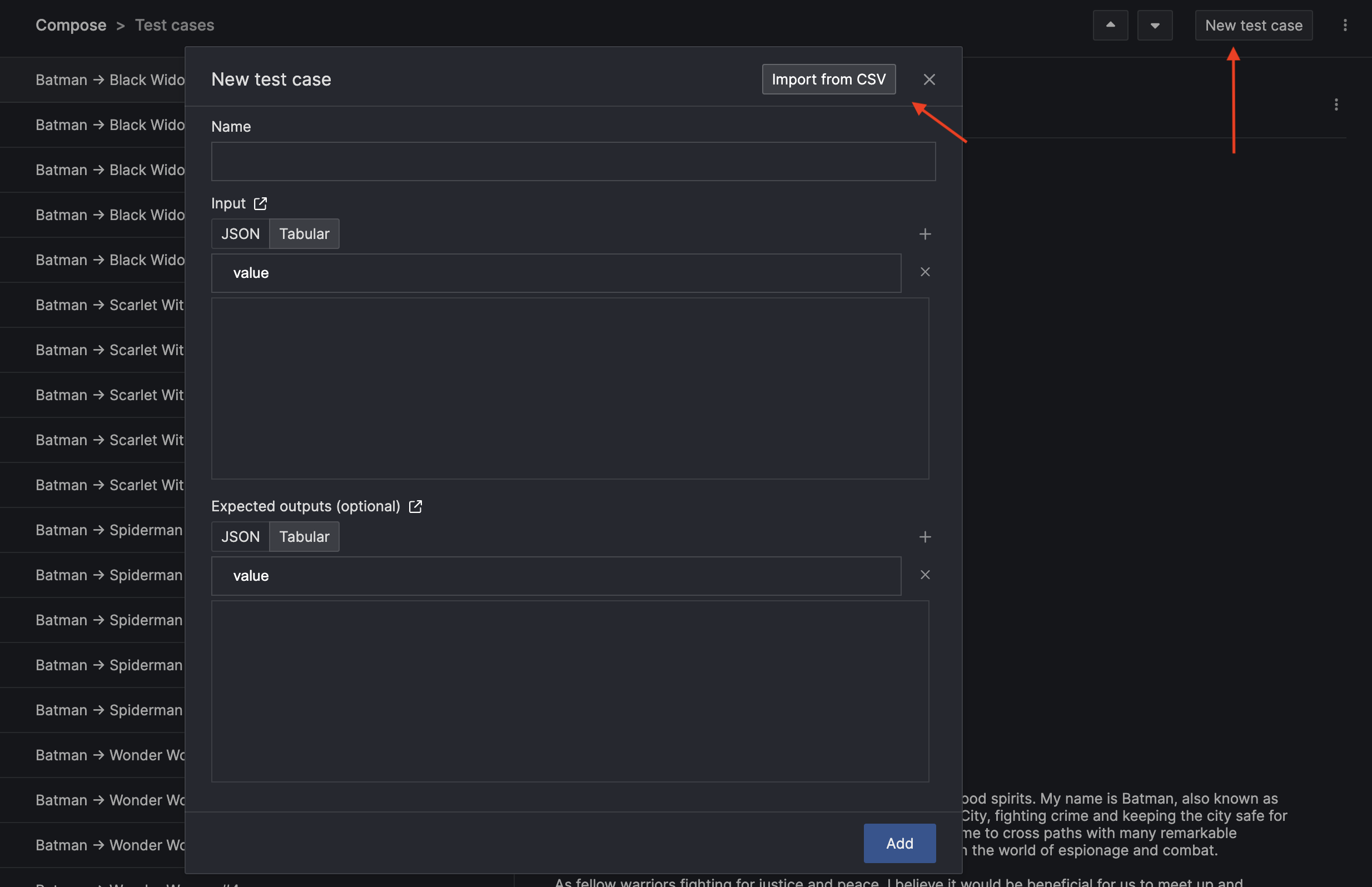
The easiest way to import large amounts of test data is through CSV files. Your CSV should have columns for the test case name, inputs, and expected outputs.
Example CSV structure:
```csv theme={null}
name,input_query,input_context,expected_response
"Billing question","How much does the premium plan cost?","New customer inquiry","The premium plan costs $29/month..."
"Technical issue","Login not working","Existing customer","Please try clearing your browser cache..."
```
To import via the web interface:
1. Navigate to your dataset in the Gentrace dashboard
2. Click "Import" and select your CSV file
3. Map the CSV columns to your dataset fields
4. Review and confirm the import
### Creating via SDK
```typescript theme={null}
import { init, datasets } from 'gentrace';
init({
apiKey: process.env.GENTRACE_API_KEY,
});
const dataset = await datasets.create({
name: 'Customer Support Evaluation',
description: 'Test cases for customer support chatbot responses',
pipelineId: 'your-pipeline-id', // or use pipelineSlug
});
console.log('Created dataset:', dataset.id);
```
```python theme={null}
import os
from gentrace import init, datasets
init(api_key=os.environ["GENTRACE_API_KEY"])
dataset = await datasets.create(
name="Customer Support Evaluation",
description="Test cases for customer support chatbot responses",
pipeline_id="your-pipeline-id" # or use pipeline_slug
)
print("Created dataset:", dataset.id)
```
## Managing test cases
Test cases are the individual data points within your dataset. You can create them one at a time or in bulk.
### Creating single test cases
```typescript theme={null}
import { init, testCases } from 'gentrace';
init({
apiKey: process.env.GENTRACE_API_KEY,
});
const testCase = await testCases.create({
datasetId: 'your-dataset-id',
name: 'Billing inquiry',
inputs: {
query: 'How do I cancel my subscription?',
context: 'Customer has active premium plan',
},
expectedOutputs: {
response:
'To cancel your subscription, please visit your account settings...',
confidence: 0.9,
},
});
```
```python theme={null}
import os
from gentrace import init, test_cases_async
init(api_key=os.environ["GENTRACE_API_KEY"])
test_case = await test_cases_async.create(
dataset_id="your-dataset-id",
name="Billing inquiry",
inputs={
"query": "How do I cancel my subscription?",
"context": "Customer has active premium plan"
},
expected_outputs={
"response": "To cancel your subscription, please visit your account settings...",
"confidence": 0.9
}
)
```
### Listing test cases
```typescript theme={null}
// List all test cases in a dataset
const testCasesList = await testCases.list({
datasetId: 'your-dataset-id',
});
// Access the test cases
for (const testCase of testCasesList.data) {
console.log(testCase.name);
console.log(testCase.inputs);
}
```
```python theme={null}
# List all test cases in a dataset
test_case_list = await test_cases_async.list(
dataset_id="your-dataset-id"
)
# Access the test cases
for test_case in test_case_list.data:
print(test_case.name)
print(test_case.inputs)
```
### Updating and deleting test cases
```typescript theme={null}
// Retrieve a specific test case
const testCase = await testCases.retrieve('test-case-id');
// Delete a test case
await testCases.delete('test-case-id');
```
```python theme={null}
# Retrieve a specific test case
test_case = await test_cases.retrieve("test-case-id")
# Delete a test case
await test_cases.delete("test-case-id")
```
## Managing datasets
### Listing datasets
```typescript theme={null}
// List all datasets
const datasetList = await datasets.list();
// Filter by pipeline
const filteredDatasets = await datasets.list({
pipelineId: 'your-pipeline-id',
archived: false, // Exclude archived datasets
});
// Access the datasets
for (const dataset of datasetList.data) {
console.log(dataset.name);
console.log(dataset.description);
}
```
```python theme={null}
# List all datasets
dataset_list = await datasets.list()
# Filter by pipeline
filtered_datasets = await datasets.list(
pipeline_id="your-pipeline-id",
archived=False # Exclude archived datasets
)
# Access the datasets
for dataset in dataset_list.data:
print(dataset.name)
print(dataset.description)
```
### Updating datasets
```typescript theme={null}
// Update dataset properties
const dataset = await datasets.update('dataset-id', {
name: 'Updated dataset name',
description: 'New description',
isArchived: false,
isGolden: true, // Mark as golden dataset
});
```
```python theme={null}
# Update dataset properties
dataset = await datasets.update(
"dataset-id",
name="Updated dataset name",
description="New description",
is_archived=False,
is_golden=True # Mark as golden dataset
)
```
## Importing data
You can import test cases from CSV, JSON, or JSONL files to quickly populate your datasets.
### CSV import
The easiest way to import large amounts of test data is through CSV files. Your CSV should have columns for the test case name, inputs, and expected outputs.
Example CSV structure:
```csv theme={null}
name,input_query,input_context,expected_response
"Billing question","How much does the premium plan cost?","New customer inquiry","The premium plan costs $29/month..."
"Technical issue","Login not working","Existing customer","Please try clearing your browser cache..."
```
To import via the web interface:
1. Navigate to your dataset in the Gentrace dashboard
2. Click "Import" and select your CSV file
3. Map the CSV columns to your dataset fields
4. Review and confirm the import
 ### JSON/JSONL import
You can also import JSON or JSONL files with structured test case data:
```json theme={null}
[
{
"name": "Billing question",
"inputs": {
"query": "How much does the premium plan cost?",
"context": "New customer inquiry"
},
"expectedOutputs": {
"response": "The premium plan costs $29/month and includes..."
}
}
]
```
## Using datasets in evaluation
Once you have datasets with test cases, you can use them to evaluate your models and pipelines.
### Running evaluations with evalDataset()
Datasets integrate seamlessly with Gentrace's evaluation system using [`evalDataset()`](./dataset-tests):
```typescript theme={null}
import { evalDataset, testCases } from 'gentrace';
await evalDataset({
data: async () => {
const testCasesList = await testCases.list({
datasetId: 'your-dataset-id',
});
return testCasesList.data;
},
interaction: yourAIFunction, // See interaction() docs
});
```
```python theme={null}
from gentrace import eval_dataset, test_cases_async
async def fetch_test_cases():
test_case_list = await test_cases_async.list(dataset_id="your-dataset-id")
return test_case_list.data
await eval_dataset(
data=fetch_test_cases,
interaction=your_ai_function, # See interaction() docs
)
```
### Golden datasets
Each pipeline can have a "golden dataset" - a special dataset that represents your core test cases. You can mark a dataset as golden when creating or updating it:
```typescript theme={null}
// Mark a dataset as golden during creation
const goldenDataset = await datasets.create({
name: 'Golden Test Cases',
description: 'Core evaluation test cases',
pipelineId: 'your-pipeline-id',
isGolden: true,
});
// Or update an existing dataset to be golden
await datasets.update('dataset-id', {
isGolden: true,
});
```
```python theme={null}
# Mark a dataset as golden during creation
golden_dataset = await datasets.create(
name="Golden Test Cases",
description="Core evaluation test cases",
pipeline_id="your-pipeline-id",
is_golden=True
)
# Or update an existing dataset to be golden
await datasets.update(
"dataset-id",
is_golden=True
)
```
## Best practices
* **Organize by use case** - Create separate datasets for different types of evaluations (accuracy, safety, performance)
* **Use descriptive names** - Make test case names clear and searchable
* **Include edge cases** - Test boundary conditions and error scenarios
* **Version your datasets** - Keep historical versions as your use cases evolve
* **Regular updates** - Add new test cases based on real-world usage patterns
* **Archive old datasets** - Use the `isArchived` flag to maintain clean dataset lists
## Next steps
* Learn about [experiments](./experiments.mdx) to compare model performance
* Set up [unit tests](./unit-tests.mdx) for continuous evaluation
* Explore [dataset tests](./dataset-tests.mdx) for comprehensive evaluation workflows
* Check out the [Test Cases SDK reference](../sdk-entities/test-cases.mdx) for more advanced usage
### JSON/JSONL import
You can also import JSON or JSONL files with structured test case data:
```json theme={null}
[
{
"name": "Billing question",
"inputs": {
"query": "How much does the premium plan cost?",
"context": "New customer inquiry"
},
"expectedOutputs": {
"response": "The premium plan costs $29/month and includes..."
}
}
]
```
## Using datasets in evaluation
Once you have datasets with test cases, you can use them to evaluate your models and pipelines.
### Running evaluations with evalDataset()
Datasets integrate seamlessly with Gentrace's evaluation system using [`evalDataset()`](./dataset-tests):
```typescript theme={null}
import { evalDataset, testCases } from 'gentrace';
await evalDataset({
data: async () => {
const testCasesList = await testCases.list({
datasetId: 'your-dataset-id',
});
return testCasesList.data;
},
interaction: yourAIFunction, // See interaction() docs
});
```
```python theme={null}
from gentrace import eval_dataset, test_cases_async
async def fetch_test_cases():
test_case_list = await test_cases_async.list(dataset_id="your-dataset-id")
return test_case_list.data
await eval_dataset(
data=fetch_test_cases,
interaction=your_ai_function, # See interaction() docs
)
```
### Golden datasets
Each pipeline can have a "golden dataset" - a special dataset that represents your core test cases. You can mark a dataset as golden when creating or updating it:
```typescript theme={null}
// Mark a dataset as golden during creation
const goldenDataset = await datasets.create({
name: 'Golden Test Cases',
description: 'Core evaluation test cases',
pipelineId: 'your-pipeline-id',
isGolden: true,
});
// Or update an existing dataset to be golden
await datasets.update('dataset-id', {
isGolden: true,
});
```
```python theme={null}
# Mark a dataset as golden during creation
golden_dataset = await datasets.create(
name="Golden Test Cases",
description="Core evaluation test cases",
pipeline_id="your-pipeline-id",
is_golden=True
)
# Or update an existing dataset to be golden
await datasets.update(
"dataset-id",
is_golden=True
)
```
## Best practices
* **Organize by use case** - Create separate datasets for different types of evaluations (accuracy, safety, performance)
* **Use descriptive names** - Make test case names clear and searchable
* **Include edge cases** - Test boundary conditions and error scenarios
* **Version your datasets** - Keep historical versions as your use cases evolve
* **Regular updates** - Add new test cases based on real-world usage patterns
* **Archive old datasets** - Use the `isArchived` flag to maintain clean dataset lists
## Next steps
* Learn about [experiments](./experiments.mdx) to compare model performance
* Set up [unit tests](./unit-tests.mdx) for continuous evaluation
* Explore [dataset tests](./dataset-tests.mdx) for comprehensive evaluation workflows
* Check out the [Test Cases SDK reference](../sdk-entities/test-cases.mdx) for more advanced usage